
Products
Spectrum Product Classifications
Explanation of Our Numbering System
Spectrum Glass is classified by a code system which permits users
to visualize the product even without a sample in hand. The system attempts
to identify colors by number, and in most cases describes lightness or darkness,
color dominance, light transmission and texture. Though the system is imperfect,
and most rules have their exceptions, with a little study and practice you will find
this a reasonably understandable method of communicating about Spectrum glass.
The code is basically numerical, with digits to designate:
- Category or general product description
- Color(s)
- Intensity of color (lightness/darkness)
- Degree of translucency
Category
Always the 1st digit in a product code
- 100 series = Cathedrals (single non-opal colors)
- 200 series = Opal glasses, either solid colors or non-white opals in a cathedral mix
- 300 series = Mix of single cathedral color with white opal
- 400 series = Mix of two cathedral colors
- 500 series = One cathedral color described by blended hues (like greenish blue)
- 600 series = Multi-color mixes (3+) including white opal
- 700 series = Multi-color mixes (3+) not including white
- 800 series = One Blended-hue cathedral (500 series) mixed with white opal
Color
Primary colors are designated as follows
- 1 = Amber
- 2 = Green
- 3 = Blue
- 4 = Purple
- 5 = Red
- 6 = Yellow
- 7 = Orange
- 8 = Gray
- 9 = Pink
- 0 = Clear
- 00 = Black
Intensity
The relative lightness or darkness of the colors, starting from 0 = clear
- 0.1 to 0.9 = pale
- 1 to 2 = light
- 3 to 4 = medium
- 5 to 6 = dark
- 7 to 9 = very dark
Translucency
The degree of light transmission, as affected by the proportion of opal, white
or colored, in the product. Actual light transmission is also related to the color
intensity and texture of the glass.
Examples
- 5 = Semi-dense (Mostly opal with swirls of color)
- 6 = Semi-translucent
- 7 = Translucent (About 50% color, 50% opal)
- 8 = Semi-transparent
- 9 = Most transparent (Mainly color with swirls of opal, "wispy")
Reading the Code
100 Series
- 1st digit-category (100 series)
- 2nd digit-indicates color
- 3rd digit-indicates intensity
Examples
- 121 = Cathedral, green, light
- 136 = Cathedral, blue, dark
- 140.8* = Cathedral, purple, pale
*Where a decimal point appears in any code it relates to a color intensity that has decreased below the number 1, thus, a pale shade.
200 Series
- 1st digit- category (200 series)
- 2nd digit- base color
- 3rd digit- added color or influencing hue
- 4th digit - after a dash, indicates translucency
- 5th digit - intensity of the dominant color
Examples
- 291-61 = Solid opal, amber-ish pink, Semi-translucent, light intensity (Champagne)
- 201-61 = Clear glass, opal amber added, semi-translucent, light intensity
300 Series
- 1st digit-indicates category (300 series)
- 2nd digit-indicates color
- 3rd digit-indicates translucency
- 4th digit-after a dash, indicates intensity of the cathedral color
Examples
- 329-6 = Opal mix, green, wispy - dark
- 347-1 = Opal mix, purple, translucent - light
- 315-2 = Opal mix, amber, semi-dense - medium
400 Series
- 1st digit-indicates category (400 series)
- 2nd digit-indicates dominant color
- 3rd digit-indicates secondary color
- 4th & 5th digits-after a dash, indicates intensity of the colors, respectively
Examples
- 411-15 = mix of two ambers, one light, one dark
- 430-6 = mix of blue and clear, blue is dark
- 451-20 = dominant red with amber, red is darker
500 Series
- 1st digit-indicates category (500 series)
- 2nd digit-indicates primary color
- 3rd digit-indicates influencing hue
- 4th digit- after a dash, indicates intensity
Examples
- 538-4 = Cathedral, grayish blue-medium
- 523-2 = Cathedral, bluish-green - light
600 Series
- 1st digit-indicates category (600 series)
- 2nd digit-indicates dominant color
- 3rd digit-indicates secondary color
- Additional digits before dash - indicate additional colors in mix
- 1st digit after dash - indicates translucency
- 2nd digit after dash (optional) - indicates intensity of dominant color
Examples
- 609-8 = White, clear & pink - semi-transparent
- 675-5 = White, orange & red - semi-dense
- 633-7 = White, blue & blue - translucent
700 Series
- 1st digit-indicates category (700 series)
- 2nd digit - indicates dominant color
- Additional digits before dash - indicate additional colors in mix, in order of dominance
- 1st digit after dash - indicates intensity of dominant colors
Examples
- 7032-6 = Clear, blue & green, - dark
- 7443-4 = Purple, purple & blue, - medium
- (these are examples only, not actual products)
800 Series
- 1st digit-indicates category (800 series)
- 2nd & 3rd digit-same as 500 series
- 4th digit-after a dash, indicates translucency
- 5th digit- indicates intensity.
Examples
- 826-71 = White, yellowish-green - translucent, light color intensity (Lime)
- 843-71 = White, bluish purple - translucent, light intensity (Lavender)
Texture Codes
Most stock numbers carry a suffix indicating the glass texture.
Not all textures are available in every product.
- S = smooth surface (untextured)
- Seedy = seedy glass
- R = Ripple
- RR = Rough Rolled
- H = Hammered
- HS = Hammered small
- G = Granite
- GG = Ice crystal
- C = Chord
- CC = Corsica
- CZ = Corteza
- QR = Quarter-Reed
- K = Krinkle
- RW = RainWater
- SN = Satin
- V = Vecchio
Type Codes
Special glass types carry a designation in their stock number, as either a suffix or a
prefix. When the type code is prefixed, a slash (/) separates it from the numerical glass
designation. Multiple type codes and texture codes can occur in the same stock
number (see examples).
* See General Information for complete definitions of each of these glass types.
- A = Artíque® (suffix)
- W = Waterglass® (suffix)
- SF = Spectrum Fusible (suffix-tested compatible products for hot glass arts)
- BR = Baroque™ (prefix)
- I = Iridescent glass (prefix)
- OA= OpalArt (prefix)
- SP = Spirit (prefix)
- T = T-Glass (prefix) (non-standard glass)
- RS = Random Size (prefix) (studio sheets)
- SC = SilverCoats (prefix)
- AA = 5mm Spectrum for the Home (prefix)
- A = 3mm Spectrum for the Home (prefix)
Examples
- I/100W = Iridescent Clear Waterglass
- I/100R = Iridescent Clear Ripple
- I/1009W = Iridescent Black Waterglass
- RS/200S = Random Size White Opal
- RS/BR/Teal = Random Size Teal Baroque
Exceptions & Oddities
Recognize that it is impossible to create a perfect numerical communication
system for a subject as infinite as color, not to mention multi-color mixes with
varying translucency, textures and special effects. So, when you find a seeming
anomaly, bear with us. Here are a few that exist now:
- 1009: Solid Black. The digit reads " cathedral, black (00), very dark (9)
- 200S = Solid White
- BR/400: Black on clear, streaky Baroque
Baroque glasses are often cathedral colors swirled into clear glass. We've chosen to designate them by color name, in many cases:
- BR/Burgundy = Burgundy swirled into clear
- BR/Cinnamon = Cinnamon swirled into clear
- BR/Clear = Clear swirled into clear
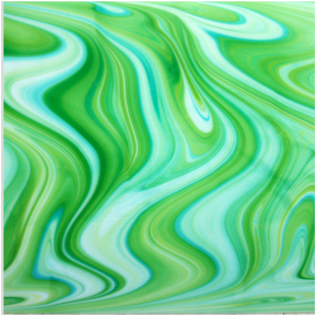
The Nature of Art Glass
Unlike common window glass, which is perfectly smooth and flawless, art glass seeks visual character through aesthetic "imperfections." These characteristics mimic the hand-made sheet glass of centuries past. They come in the form of textural waves and striations, random seeds (air bubbles) and a variety of other natural effects. Art glass achieves its personality through these peculiarities, and no two sheets are ever identical.